


Qrendi, where history lives on in its streets, fields, churches and cliffs.
Village, countryside, coast and layers of time are woven together seamlessly in the village
Some places never truly leave you. Qrendi is one of these for me. I grew up coming here day after day to walk, jog and run along the main road that leads down to the Wied iż-Żurrieq promenade. I also worked in the village for 12 years. Living in nearby Mqabba, close enough for Qrendi to feel like an extension of home, I still discover something new every time I return on foot.
Where the village begins I begin where the village rises to meet you, at the Parish Church of the Assumption. Sitting at the highest point of Qrendi, this cruciform baroque church was designed by Lorenzo Gafà and completed in 1712. Its honey-coloured limestone façade anchors the skyline, while inside, light and devotion fill the space. Among the many religious works, one painting always captures my attention. It depicts the Santa Marija Convoy, when the tanker Ohio limped into Grand Harbour on 15th August 1942, bringing desperately needed supplies to a struggling Malta. Faith and survival intertwine here, as they do throughout the village. Winding streets and living architecture from the church square, I step into the quiet heart of Qrendi. Narrow, winding streets shaped long before cars existed gradually reveal the village’s traditional Maltese architecture: limestone façades softened by time, carved details, stone niches sheltering saints, and a small muxrabija – a type of enclosed latticework wooden box for privacy, allowing for peeping onto the street without being seen, while also letting air and light through. Triq il-Kbira (Main Street) bisects the village, carrying you into another era. The village core remains calm and largely intact, even as modern development presses in on the outskirts, a familiar contrast across Malta.

Religion is deeply woven into this landscape. There are seven churches in Qrendi, most built over earlier structures. Walking towards the votive church of St Anne, erected in thanksgiving after the Great Siege of 1565, one cannot help but feel how history, gratitude and belief are etched into stone. The church of St Catherine tat-Torba holds a quiet secret: a cherished statue of Christ the Redeemer. On rare occasions when the church is open, I slip inside and linger, admiring the statue amid the austere beauty of Maltese stone. It remains one of my personal favourites.
Knights, towers and palaces A short stroll reveals a 17th-century windmill, once essential to village life, and nearby, the striking octagonal Cavalier Tower. One of the few surviving late medieval towers in Malta, it once served as the residence of a captain of the Knights of St John from where he commanded the local militia. Qrendi may be small, but it has played its part in the defence of the surrounding area. Scattered around the village are several palazzos that served as summer residences and were built by Knights and notable families seeking some tranquillity. Among those still standing proudly today, quite old are the Gutenberg Palace in Triq il-Fulija, the Guarena Palace on the way to Ħaġar Qim and Mnajdra Temples, and the beautifully restored De Piro Palace in San Salvatur Square. Others line Triq il-Kbira, including one beside a former convent and another almost opposite. The Palazzo Buon Consiglio, once the largest, had a magnificent garden that was partly lost when the road in front of the parish church was built in the 1960s.

Gardens, potatoes and rural identity Green spaces appear unexpectedly. On the way towards St Catherine’s Church lies the walled Tal-Kmand Garden, established during the early British period by Sir Alexander Ball. Along its history, it served as both a leisure garden and an experimental agricultural centre. Various crops were tested here, including the potato. This humble vegetable went on to define Qrendi’s modern identity. Today, the village is known as the potato harvesting capital of Malta. Potatoes remain one of the island’s main exports, and every year, towards the end of May, Qrendi celebrates the Potato and Agrarian Festival. The potato takes centre stage in all its forms, from cinnamon ice cream to cocktails, reflecting the village’s playful creativity.
Bread, grocers and everyday rituals I often come here for one simple ritual: buying freshly baked Maltese bread from a traditional stone-oven bakery. The scent of warm crust and wood smoke fills the street long before you reach the door. Inside, loaves are still baked the old way; their dark, crackling crusts bearing the marks of generations. Carrying a loaf under my arm, still warm, feels like holding a piece of living heritage. A stone’s throw away from the parish church, two small grocers continue to trade much as they always have. Their modest shelves and counters, worn smooth by decades of use, are reminders of a Malta where daily life unfolded at a human scale. You buy what you need, exchange a few words, and leave with more than groceries.

From village to countryside Leaving the streets behind, I step into the countryside. Scattered farmhouses and old cottages, along with remnants of spy holes carved into the stone, catch my eye as I walk. Dry stone walls frame the cultivated fields, while Royal Cypher demarcation markers appear unexpectedly along the way. These markers indicate that the land behind them was once Crown property. They bear the initials GR, likely referring to King George IV, who reigned from 1820 to 1830. The air feels fresher and quieter here, carrying a calm that slows my pace and invites me to take in the stillness around me.
I make my way towards Madonna tal-Ħniena, the Sanctuary of Our Lady of Mercy, a place I have long wanted to visit. I imagine the sanctuary as it was in the 17th century, when it was rebuilt to welcome the growing number of pilgrims. During restoration work in 2021, remains of the old church, probably dating back to the late medieval period, were discovered beneath the current building. Commendatore Fra Wolfgang Philippus von Guttenberg, the Knight who had his summer lodge nearby, donated various artworks to this church. Once serving the lost hamlet of Ħal-Lew, the church houses numerous ex-voto paintings that tell stories of devotion spanning centuries, testifying to the devotion of pilgrims over time. Standing there, I feel a connection to all those who have walked this path long before me and left struck by this treasure in this remote corner of Malta.
Temples, valleys and the sea An uphill climb and gentle downhill walk take me back in time to the Ħaġar Qim and Mnajdra Temples. Dating from 3600 to 3200 BC, they predate the pyramids yet feel startlingly alive. From the limestone cliffs, with Filfla in the distance, their scale and endurance are breathtaking. Nearby, Il-Misqa, the watering place, whispers of Neolithic ingenuity, and I feel transported to a faraway, unspoilt world. Beyond the temples, the land drops away dramatically towards the sea. Coastal watchtowers, including Ħamrija and Xutu, stand as sentinels of Malta’s defensive past. At the cliff edge, Tal-Ħamrija Cave and the Congreve Memorial lie in quiet contemplation. My descent to hidden coves and tiny, unspoilt beaches is steep but spellbinding, each winding path revealing a secret world where nature flourishes in full bloom.
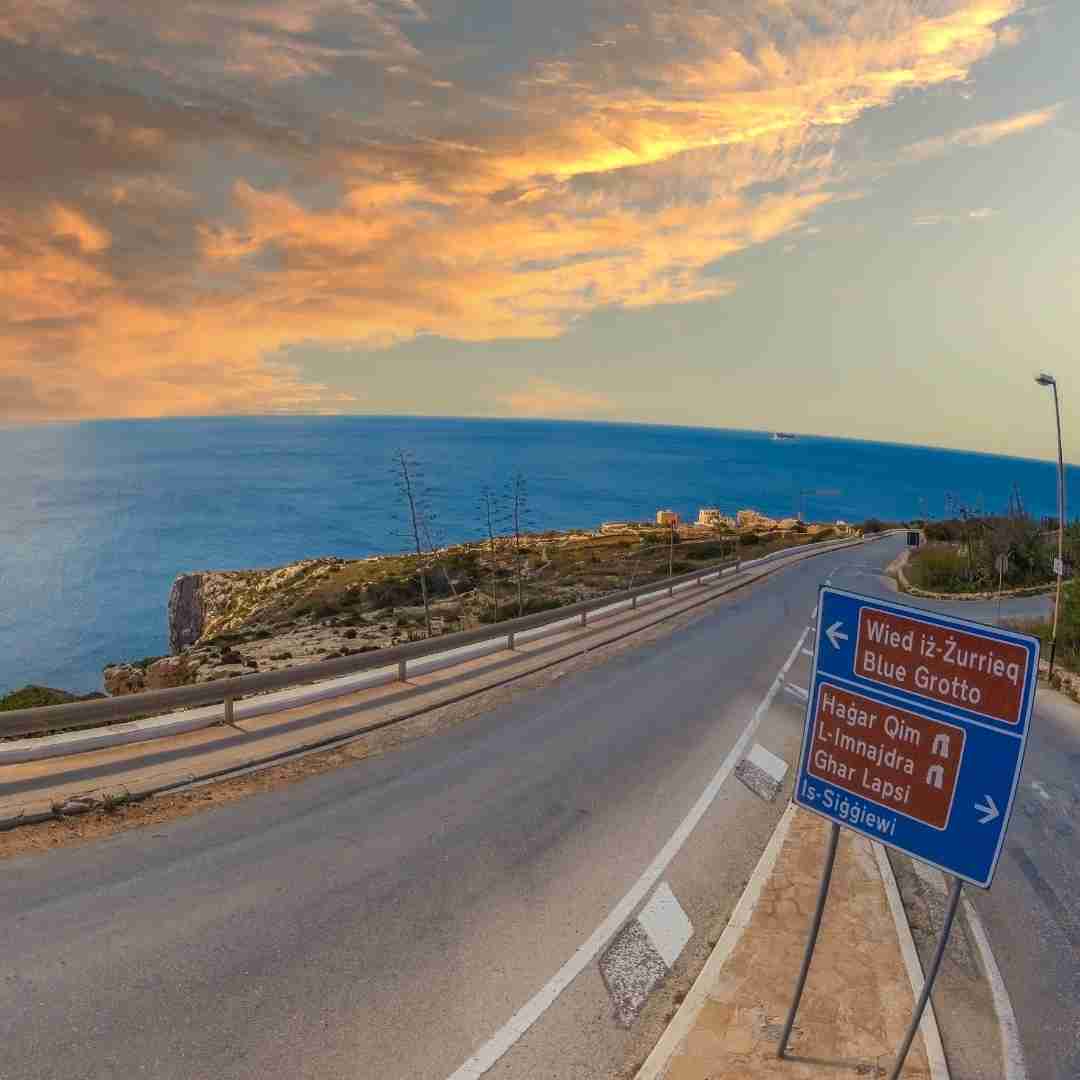
The walk ends at Wied iż-Żurrieq, once a fishing hamlet at the mouth of a valley carved during the last ice age. Swimming here, I am captivated by the landscape, with Filfla seemingly close enough to touch. Afterwards, I rest on sun-warmed rocks, enjoying fresh seafood and a glass of Maltese wine. Boat trips reveal the Blue Grotto, a complex of seven sea caves where sunlight transforms the water into vivid blues and greens. Each visit leaves me in awe of this remarkable union of geology, light and sea. A place that unfolds slowly as I finish my walk, with water gently washing against the rocks and Filfla resting on the horizon, Qrendi feels complete. Village, countryside, coast and layers of time are woven together seamlessly. History lives in its streets, fields, churches and cliffs.

Legend and landscape at Maqluba It is always exciting to visit the iconic Maqluba Square, home to the Church of San Mattew tal-Maqluba and a smaller cliff-edge church that feels distinctly ancient. This place is especially meaningful to me as one of my nephews was named after the titular saint. St Matthew’s Crypt, the smaller church, has plain exterior walls with windows added later. Inside, I was astonished by a striking 17th-century scallop shell fresco. The crypt’s size has been reduced by a stairway leading to the larger church. Behind the churches lies the Maqluba sinkhole, which formed during a storm in 1343. Legend tells of a sinful settlement swallowed whole, while angels flung the debris into the sea, creating the islet of Filfla. Walking to the edge, I am struck by the sheer scale, the silence and the beauty of this extraordinary place.
Qrendi feels familiar, yet always new. Take your time, wander its streets, and let it surprise you.Visit Malta and explore beyond the obvious.
